Field observation
Most technology problems
are not technology problems.
They are decisions that were never resolved.
Governance is the architecture of decisions that must hold under pressure.
The real operating problem is usually less visible than the tools under discussion.
Field markers
What shows up before technology does
-
01
Technology decisions often reveal operating decisions that were never resolved.
-
02
Systems rarely fail alone. They expose gaps between ownership, process, and information.
-
03
Transformation slows when responsibility is unclear, not when software is missing.
A common pattern
Many organizations experience separate conversations
The work is understanding where those conversations stopped connecting.
Decision architecture
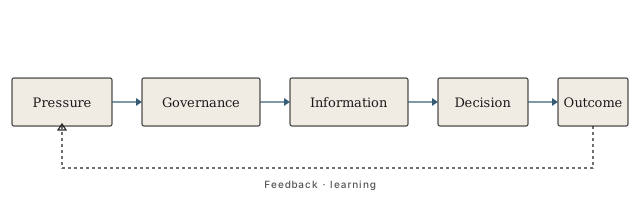
How decisions are supposed to travel
A line drawing of pressure, governance, information, decision, and outcome - with feedback so learning is retained.
-
01
Pressure
Demand enters the system.
-
02
Governance
Structure that must hold under pressure.
-
03
Information
What leaders can actually see.
-
04
Decision
Ownership becomes real.
-
05
Outcome
Results that feed learning.
-
06
Feedback
Learning is retained, not lost.
Operating picture
Layers leaders must coordinate
These layers already exist. Friction appears when they are treated as separate conversations. Eden Operating Model
Governance is not about control. It is about creating the conditions for good decisions to be made repeatedly.
Eden principle
Method
Understand. Design. Improve.
A disciplined sequence - not a catalog of capabilities.
-
01
Understand
See the real operating problem before selecting technology.
-
02
Design
Align decisions, ownership, and systems so work can move.
-
03
Improve
Support adoption as the organization grows.
Experience
What leaders believed, and what was actually stuck
Illustrative patterns
Named stories require permission. These patterns show how pressure is typically misread.
Delivery without a shared operating picture
- Believed
- Better project software
- Actually
- Ownership of delivery was unclear
- Clearer
- One current picture of work before new systems
Field and office held different truths
- Believed
- A better document portal
- Actually
- Two operating models never reconciled
- Clearer
- One package of work both sides could trust
Growth outpaced access discipline
- Believed
- An IT security problem
- Actually
- Access and visibility were operating gaps
- Clearer
- Security as operating discipline with leadership view
What worked at ten failed at fifty
- Believed
- An all-in-one system now
- Actually
- Exceptions had become the operating system
- Clearer
- Stabilize ownership before committing to a platform
Eden Briefing
Observations from organizations navigating complex change
Research notes and executive memos. Forward-worthy judgment, or not published.
Why transformation programs slow before technology begins
Programs stall when ownership and decisions are unresolved.
Research noteThe hidden ownership problem inside system fragmentation
Fragmentation is often described as systems when ownership is missing.
Field observationWhen AI adoption reveals operating model weaknesses
New tools expose decision and responsibility gaps first.
PrincipleBuilding systems that scale
Scale fails when ownership and decisions do not scale with the tools.
Research noteWhen automation actually saves money
Automation pays when the work and decisions are already clear.
Field observationWhen software choices become operating decisions
Buy vs build is often a decision-architecture question first.